
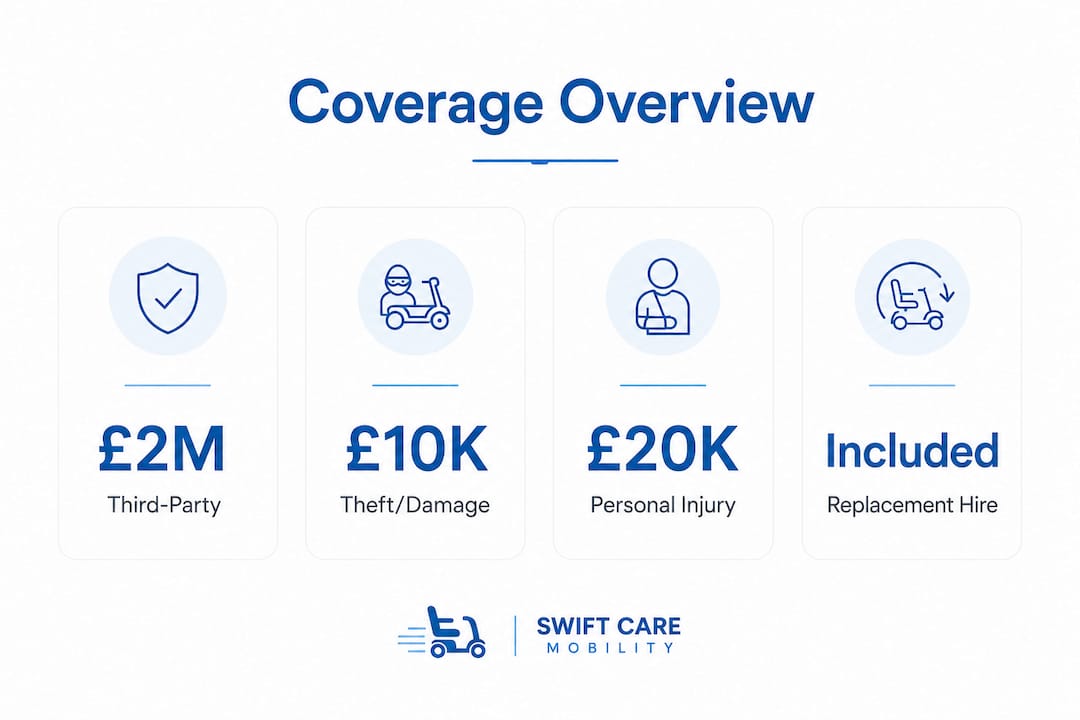
Mobility scooter insurance in the UK is defined as a specialist policy covering theft, accidental damage, and third-party liability for powered mobility devices. The Department for Transport recommends public liability cover for all scooter users, even though insurance is not legally required for Class 2 or Class 3 scooters. A standard policy typically includes up to £2 million third-party liability, £10,000 theft and damage cover, and £20,000 personal accident protection. Knowing what cover you need, and what the law actually requires, saves you money and keeps you protected on the road.
What does mobility scooter insurance typically cover in the UK?
Policies generally cover theft, accidental damage, third-party liability, and personal accident as standard. The scope varies between providers, so reading the policy schedule carefully is the most reliable way to avoid gaps.
Core coverage types and typical limits
| Coverage type | Typical limit |
|---|---|
| Third-party liability | Up to £2 million |
| Theft and accidental damage | Up to £10,000 |
| Personal accident | Up to £20,000 |
| Travel cover abroad | Up to 90 days per year |
| Breakdown and replacement hire | Varies by policy |

Typical coverage limits reach £2 million for third-party liability, £10,000 for theft and damage, and £20,000 for personal accident claims. Those figures reflect the real financial exposure a scooter user faces if they cause an injury or write off their vehicle.
Beyond the core cover, many policies include useful extras. Replacement hire gives you a scooter while yours is being repaired. Broken key cover handles locksmith costs. Some policies extend protection to short trips abroad, covering up to 90 days in a 12-month period. That last point matters for users who travel to Europe with their scooter.
Pro Tip: Check whether your policy covers you on public transport, such as when your scooter travels in the hold of a ferry or coach. Not all policies include transit damage.
Public liability cover is the single most important element. A collision with a pedestrian or a parked car can result in a claim worth tens of thousands of pounds. Without cover, you pay that from your own pocket.
Is mobility scooter insurance legally required in the UK?
Insurance is not legally required for Class 2 or Class 3 scooters in the UK, but the Department for Transport strongly advises carrying public liability cover. That distinction matters. "Not required" does not mean "not needed."
Class 2 and Class 3 scooters
Class 2 scooters are limited to 4mph and are designed for pavement use. Class 3 scooters reach 8mph and are permitted on roads. Neither class requires compulsory insurance under current UK law. Both classes do, however, expose users to real liability if an accident occurs.
Out-of-class scooters: a different legal position
Out-of-class scooters sit outside the standard Class 2 and 3 definitions. They typically exceed the weight or speed thresholds set by the Department for Transport. These vehicles require DVLA registration, a valid driving licence, and compulsory motor insurance, exactly as a car does.
The ETA stresses that correct scooter classification is critical. Owners who misclassify their scooter risk driving uninsured without realising it. That can result in prosecution, fines, and an unenforceable claim if an accident occurs.
| Scooter class | Max speed | Road use | Insurance required by law | Insurance recommended |
|---|---|---|---|---|
| Class 2 | 4mph | Pavement only | No | Yes |
| Class 3 | 8mph | Roads and pavement | No | Yes |
| Out of class | Above thresholds | Roads | Yes | Yes |
Pro Tip: If you are unsure which class your scooter falls into, check the manufacturer's specification sheet against the Department for Transport's classification criteria before purchasing a policy.
The practical takeaway is straightforward. If your scooter is Class 2 or 3, insurance is optional but sensible. If it falls outside those classes, insurance is a legal obligation. Getting the classification wrong is not a minor administrative error. It is a legal risk.
How much does mobility scooter insurance cost in the UK?
Standard premiums start at around £65 per year for scooters valued up to £3,500. That figure covers basic comprehensive protection including theft, damage, and public liability. For most users, it represents good value against the financial exposure of an uninsured incident.
Households with two scooter users benefit from bundled cover. Bundled policies for two people at the same address are available for around £90 per year. That works out at roughly £45 per person, which is considerably cheaper than two separate policies.
Factors that affect your premium
- Scooter value. Higher-value scooters attract higher premiums because the theft and damage payout is larger.
- Coverage level. Adding breakdown recovery, replacement hire, or extended travel cover increases the annual cost.
- Excess amount. Choosing a higher voluntary excess reduces your premium but increases your out-of-pocket cost at claim time.
- Location. Urban areas with higher theft rates can push premiums up slightly.
- Usage frequency. Daily outdoor use carries more risk than occasional indoor use, and some insurers price accordingly.
Insurance premiums vary based on all these factors, so two users with similar scooters can end up paying noticeably different amounts. Getting a quote that reflects your actual usage pattern gives you the most accurate price.
Pro Tip: If you plan to upgrade your scooter within the year, ask your insurer about policy portability before you buy. Portable insurance policies transfer to your new scooter without requiring a fresh application, preventing any gap in cover.
One cost-saving approach is to review your coverage annually. As your scooter ages and its market value falls, you may be able to reduce the theft and damage limit and lower your premium accordingly.
How do you choose the best mobility scooter insurance for your needs?
The best policy matches your scooter's value, your typical usage, and your personal risk tolerance. A user who rides daily on busy pavements needs different cover from someone who uses a scooter occasionally indoors.
Steps to evaluate a policy
- Assess your scooter's value. Check the current replacement cost, not the original purchase price. Insuring for the wrong amount leaves you undercompensated after a theft.
- Identify your usage environment. Outdoor, road-adjacent use carries more liability risk than indoor or garden use. Choose a liability limit that reflects where you ride.
- Review what is excluded. Policies commonly exclude wear and tear, pre-existing damage, and use outside the UK beyond the stated travel limit. Read the exclusions section before signing.
- Check the claims process. A policy with a straightforward telephone or online claims process is worth more in practice than a cheaper policy with a slow or complex procedure.
- Compare basic and comprehensive cover. Basic cover typically handles theft and damage only. Comprehensive cover adds public liability, personal accident, and extras like breakdown recovery. The price difference is often small, but the protection difference is significant.
- Confirm portability. If you are likely to upgrade your scooter, choose a policy that transfers to a new vehicle without a penalty or reapplication.
The difference between basic and comprehensive cover is often less than £20 per year. For that amount, you gain public liability protection worth up to £2 million. That trade-off strongly favours comprehensive cover for most users.
Pro Tip: Ask your insurer directly whether the policy covers you if a family member or carer uses your scooter. Many policies restrict cover to the named policyholder only.
Caregivers arranging insurance on behalf of a family member should check that the policy names the actual user, not just the person paying the premium. Some insurers require the primary user to be the named insured for a claim to be valid.
Key takeaways
Mobility scooter insurance in the UK is not legally required for Class 2 or 3 scooters, but public liability cover is strongly recommended by the Department for Transport to protect against financially significant third-party claims.
| Point | Details |
|---|---|
| Legal requirement by class | Class 2 and 3 scooters need no compulsory insurance; out-of-class scooters do. |
| Core coverage limits | Typical policies offer £2 million liability, £10,000 damage, and £20,000 personal accident. |
| Annual cost benchmark | Basic comprehensive cover starts at around £65 per year for scooters up to £3,500. |
| Bundled household savings | Two users at the same address can share cover for around £90 per year. |
| Policy portability | Choose a transferable policy to avoid coverage gaps when upgrading your scooter. |
Why I think most scooter owners underestimate their liability exposure
Most people who skip insurance do so because they assume their home contents policy or personal accident cover picks up the risk. It rarely does. Standard home insurance excludes motorised vehicles used outside the home, and personal accident cover does not pay third-party claims at all.
The liability gap is the real danger. A scooter travelling at 4mph can still knock over an elderly pedestrian and cause a serious injury. A claim for medical costs, lost earnings, and pain and suffering can run to tens of thousands of pounds. Without public liability cover, that bill lands entirely with the scooter user.
The other misconception I see regularly is that insurance is only worth buying for expensive scooters. A £1,500 scooter stolen from outside a supermarket is a significant financial loss for most households on a fixed income. The £65 annual premium to protect it is not optional spending. It is basic financial sense.
The scooter market has expanded considerably in recent years. Folding travel scooters, heavy-duty outdoor models, and lightweight indoor options all carry different risk profiles. Insurance products have kept pace, and there are now policies tailored to each usage type. The choice is better than it has ever been. The only mistake is not using it.
— Edmond
Mobility scooters from Swiftcaremob: shop with confidence
Choosing the right scooter is the first step. Protecting it is the second. Swiftcaremob offers a broad range of electric, folding, and heavy-duty mobility scooters with rapid nationwide delivery and a 12-month warranty included as standard.
Browse the full mobility scooter range to find a model that suits your needs, whether you need a compact travel scooter or a robust outdoor model. Once you have chosen your scooter, arranging insurance alongside your purchase means you are covered from day one. Swiftcaremob's team can point you toward the right scooter class and specification, giving you the information you need to get the correct policy in place. View all scooters and accessories online today.
FAQ
Is mobility scooter insurance legally required in the UK?
Insurance is not legally required for Class 2 or Class 3 scooters. Out-of-class scooters that exceed standard weight or speed thresholds do require compulsory insurance under UK motor vehicle law.
What does a standard mobility scooter policy cover?
A standard policy covers theft, accidental damage, and third-party liability up to £2 million. Many policies also include personal accident cover up to £20,000 and optional breakdown recovery.
How much does mobility scooter coverage UK typically cost?
Basic comprehensive cover starts at around £65 per year for scooters valued up to £3,500. Two users at the same address can access bundled cover for approximately £90 per year.
Can I transfer my insurance to a new scooter?
Most policies are transferable to a replacement scooter, but you must notify your insurer promptly to maintain continuous cover. Choosing a portable policy before you buy prevents any gap in protection.
Does home insurance cover my mobility scooter?
Standard home contents insurance generally excludes motorised vehicles used outside the home. A dedicated mobility scooter policy is the reliable way to cover theft, damage, and public liability.